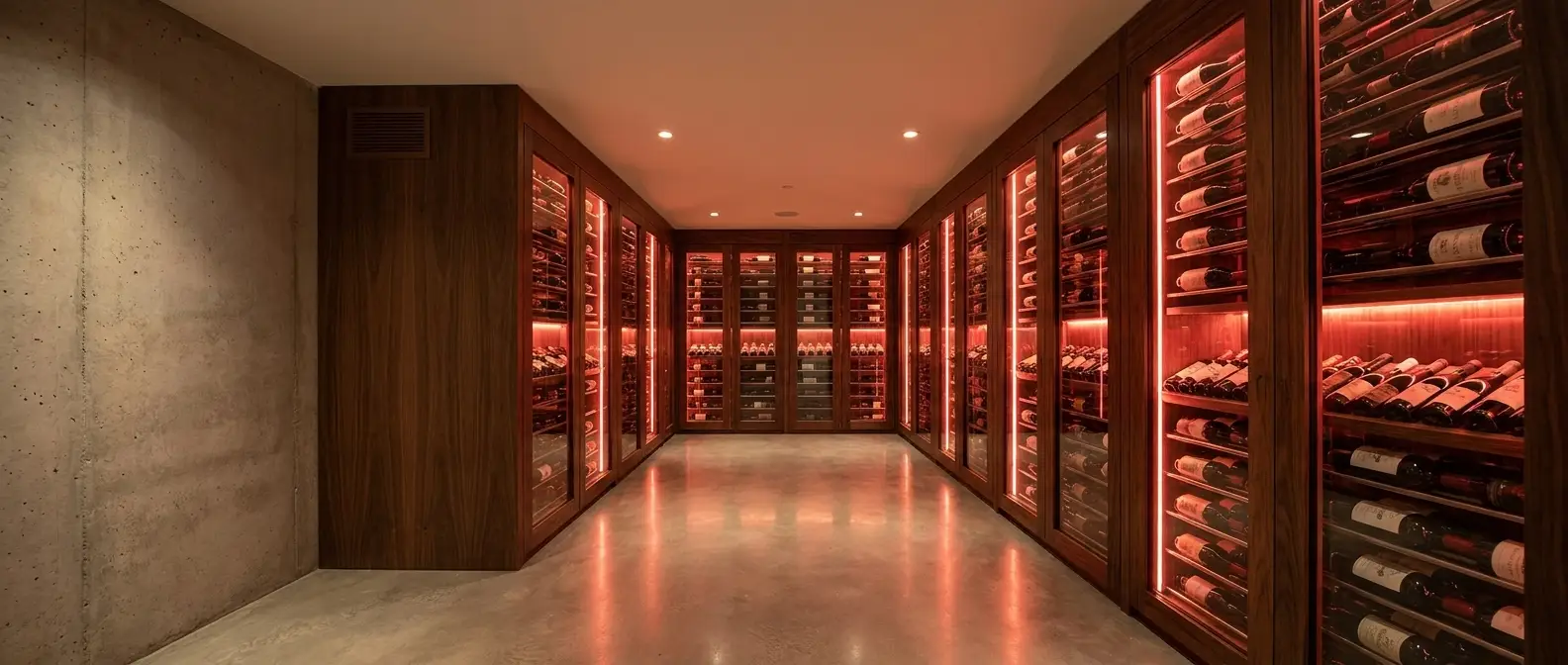
Wine Storage Guide
Ducted wine cellar
cooling
One cabinet outside the cellar, insulated ducts in. Factory-sealed refrigerant, licensed install, ±2°C / ±4°F locked around the setpoint. The architecture wine cellars are built around when the interior matters and the install has to last.
Cellar setpoint
55°F
Inside a 50–70°F operating band
Stability
±2°C / ±4°F
Factory-locked differential
Condenser ambient
50–77°F
Required window for the cabinet room
Install requirement
Licensed HVAC
DIY voids warranty
The one-paragraph answer
A ducted wine cellar cooling system is a factory-sealed cabinet installed outside the finished cellar, routing insulated supply and return ducts into the room. The cabinet needs a tempered adjoining space with 50–77°F ambient. Panthaire APEX 3500 / 5000 / 7000 covers cellars up to 900, 1,200, and 2,000 ft³ with a ±2°C / ±4°F factory-locked differential on R290 natural refrigerant. Licensed HVAC install required; DIY voids the warranty.
Written and reviewed by
Panthaire HVAC Engineering Team · Licensed HVAC · Wine Cellar Cooling Specialists
The team that engineers APEX is the same team that ships it and answers the phone when installers call.
Last reviewed · July 2, 2026
Quick answer
What ducted wine cellar cooling actually is.
A ducted wine cellar cooling system is a self-contained cabinet installed outside the finished cellar, in an adjoining mechanical room, a walk-in closet, or a conditioned attic, that routes insulated supply and return ducts into the cellar through concealed grilles.
The refrigerant loop is sealed at the factory. On-site work is duct connections, electrical hookup, and commissioning the wired control panel, not field-charging refrigerant. The cabinet is accessible without entering the cellar, and the cellar interior shows only grilles.
Panthaire APEX is the ducted architecture in this category: three models covering cellars up to 900, 1,200, and 2,000 cubic feet, running on R290 refrigerant with a ±2°C / ±4°F locked differential and a 2 years warranty.
How it works
Six things a ducted install actually involves.
Not a marketing sequence: the actual decisions and constraints. Read this before you spec a cabinet room or sign an installer. The full sequence lives in the wine cellar cooling installation guide.
The cabinet lives outside the cellar
APEX sits in a tempered adjoining space, such as a mechanical room, closet, or conditioned attic, where ambient stays between 50°F and 77°F. Nothing mechanical intrudes on the finished cellar. Serviceability doesn't require entering the cellar or moving bottle inventory.
Supply and return ducts do the work
Insulated round duct (flex or rigid) delivers cool air near the ceiling and pulls warm air from the opposite low corner or near the door. Short, straight runs win: every bend adds static pressure the blower has to overcome; long runs let ambient heat leak in even through R-6 insulation.
The unit holds ±2°C / ±4°F around setpoint
The controller runs the compressor to a factory-locked differential rather than the wider bands consumer thermostats use. Set 55°F, the unit cools to 53°F, stops, restarts at 57°F. That tight cycle is why ducted purpose-built systems hold cellar wine cleanly where mini-splits overshoot.
Sealed R290, not field-charged
The refrigerant loop is charged and pressure-tested at the factory. Installers connect ducts and electrical, not refrigerant lines. R290 (a hydrocarbon) has a Global Warming Potential of 3 and is the refrigerant the industry is transitioning to under the AIM Act HFC phase-down.
Sizing follows cubic footage and envelope
Cooling load is calculated by cellar volume and insulation grade, with roughly a +15% adjustment for glazed cellars. Undersizing forces continuous run-time and drift; gross oversizing short-cycles the compressor and kills its life. APEX covers 900 / 1,200 / 2,000 ft³ across three models, and most cellars land on one cleanly.
Licensed HVAC install, not DIY
Duct fabrication, dedicated 15A or 20A circuit, correct condensate handling, control-panel commissioning: this is HVAC work with cellar-specific knowledge attached. DIY installation voids the APEX warranty. The Panthaire team refers installers and provides a five-question script to vet cellar-cooling experience.
How to size it
Six steps to the right APEX model.
Not a calculator substitute. This is the mental model behind the calculator. Learn it once so the number the calculator returns makes sense, and so you can sanity-check any installer’s sizing quote against a known method. Still deciding the room itself? Start with the how to build a wine cellar checklist, then come back here for ducted sizing. If you only have a bottle count, start with the bottle-count sizing pages.
Measure the cellar volume
Multiply the cellar's interior length, width, and height in feet to get cubic footage. Include all volume inside the insulated envelope, not just the visible bottle-rack area. A 10 × 8 × 8 cellar is 640 ft³; a 12 × 10 × 9 cellar is 1,080 ft³.
Identify the insulation grade
Confirm the R-value of walls and ceiling. R-20 is the baseline capacity ratings assume; R-30 is preferred for cold-climate builds. Below R-20, either upgrade the envelope (usually cheaper than upsizing) or account for a higher BTU load in the next step.
Calculate the base BTU load
For an R-20 envelope, plan on roughly 3.5–4.5 BTU per cubic foot of cellar volume. A 640 ft³ cellar at that ratio needs 2,240–2,880 BTU of cooling capacity; a 1,080 ft³ cellar needs 3,780–4,860 BTU. Below R-20, add 15–25% to the load.
Add the glazed-area adjustment
Any glass door, glass wall, or glass panel adds roughly 15% to the total load compared to an equivalent insulated wall. A cellar with a full glass entry door in a 4 × 7 opening should be sized as if it were about 15% larger than its actual cubic footage.
Match total BTU to an APEX model
APEX 3500 (3,353 BTU) covers cellars up to about 900 ft³. APEX 5000 (4,462 BTU) covers up to 1,200 ft³. APEX 7000 (6,346 BTU) covers up to 2,000 ft³. Choose the model whose capacity clears the calculated load with a small margin, never the largest unit that fits, which causes short-cycling and shortens compressor life.
Verify the ambient window at the cabinet location
The room where the ducted cabinet will sit must maintain 50°F to 77°F ambient temperature year-round. Confirm this before framing. Garages, uninsulated attics, and unconditioned crawlspaces fall outside the window and disqualify a location regardless of BTU sizing.
The other option
Ducted vs ductless, side by side.
Both architectures cool a wine cellar. They solve different problems. This is the honest comparison; the recommendation is at the bottom.
| Criterion | Ducted | Ductless |
|---|---|---|
| Where the mechanical equipment lives | Outside the cellar, in an adjoining tempered space. | The evaporator sits inside the cellar (wall, ceiling, or vertical head). |
| Refrigerant handling | Sealed at the factory. Installer connects ducts and electrical only. | Refrigerant lines run between condenser and evaporator; installer charges and pressure-tests on site. |
| Cellar interior appearance | Only grilles are visible in the room. | Evaporator head or vertical unit is visible on a wall. |
| Long-term serviceability | Cabinet accessible from outside the cellar. No need to move bottles for service. | Some access work happens inside the cellar. Bottles nearby may need to move. |
| Typical retrofit difficulty | Requires an adjoining tempered space and room to route insulated duct. | Easier to retrofit into existing spaces, with no ducts to route through finished walls. |
| Panthaire APEX | APEX 3500 / 5000 / 7000: ducted, self-contained, three mounting positions. | APEX does not ship a ductless SKU. See the ductless guide for when that architecture is the right call. |
The short answer: if the cellar has an adjoining tempered space for a cabinet, ducted wins on cellar aesthetics, install simplicity (no on-site refrigerant charge), and long-term service access. If it doesn’t, ductless can be the right call. Read our ductless wine cellar cooling guide for that side of the decision.
The APEX lineup
Three cabinets, one ducted architecture.
Same self-contained ducted design across the range. Choose by cellar volume; the physics (±2°C / ±4°F differential, R290 refrigerant, 50–77°F ambient window, licensed-HVAC install) is identical model to model.
3,353 BTU
APEX 3500
Cellars up to 900 ft³
$5,599.95USD
Spec sheet4,462 BTU
APEX 5000
Cellars up to 1,200 ft³
$5,725.95USD
Spec sheet6,346 BTU
APEX 7000
Cellars up to 2,000 ft³
$6,995.95USD
Spec sheetFAQ
Questions builders and buyers actually ask.
A ducted wine cellar cooling system is a self-contained cabinet installed outside the finished cellar, typically in an adjoining mechanical room, closet, or conditioned attic, that routes insulated supply and return ducts into the cellar through grilles. The refrigerant loop is sealed at the factory, so the on-site install work is duct connections and electrical, not refrigerant charging. Because the cabinet lives outside the cellar, the cellar interior shows only supply and return grilles.
References
Where these numbers come from.
- U.S. EPA: Phasedown of Hydrofluorocarbons under the AIM Act (2020)
Federal timeline for the R410A / R134a phase-down that R290 replaces.
- APEX User Manual (current revision)
Canonical source for the ±2°C / ±4°F differential, defrost cycle, ambient window, and warranty terms cited throughout this guide.
- Panthaire BTU calculator methodology
The sizing calculator that codifies the six-step method above.
- Panthaire Pro spec kit
Drawings, specify-APEX one-pager, and a saved project for designers and contractors.
Start with the size
Match a cabinet to your cellar in ninety seconds.
Cubic feet, insulation grade, glass adjustment. The BTU calculator returns the APEX model that fits, plus the two ambient checks the install has to pass before framing.